









Related Theories
- Media Richness
Theory
Daft and Lengel (1986), in their seminal work on media richness, postulate that media differ in information richness and thus on their capacity to facilitate shared meaning at a given time horizon. According to media richness theory, in order for richer information to be transmitted, media should foster higher interactivity. The theory further holds that there are four factors influencing media richness:
The ability of the medium to transmit multiple cues
Immediacy of feedback
Language variety
Personal focus of the medium
- Social Presence
Theory
Social presence theory (Short, Williams, & Christie, 1976) suggests that communication media that convey low social presence (such as text-only communication) should prove less effective for tasks requiring high personal involvement.
Webster’s
Definition
- Mutually or reciprocally
active
- Of, relating to,
or being a two-way electronic communication system (as a telephone,
cable television, or a computer) that involves a user's orders (as for
information or merchandise) or responses (as to a poll)
From
Human-computer Interaction Literature
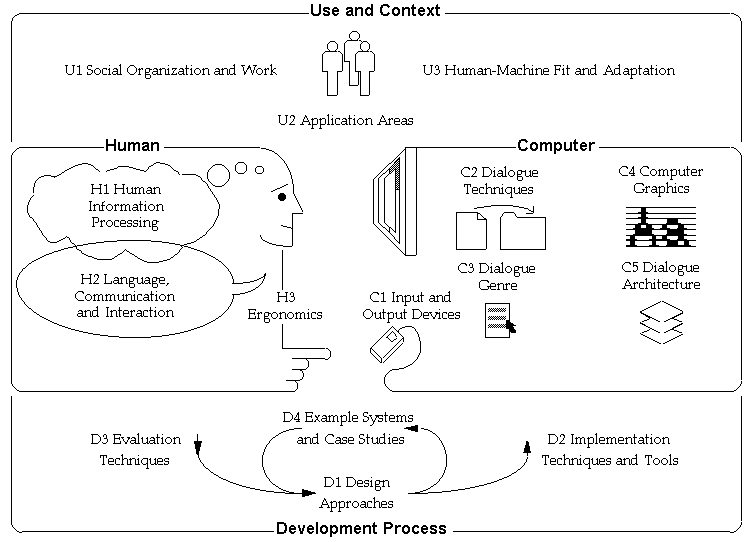
The above chart is copied from http://sigchi.org/cdg/cdg2.html#2_1
From a computer science perspective, human-computer interaction involves
transducers between humans and machines based on the assumption that humans
are sensitive to response times. In particular, HCI is composed of the
following characteristics:
Ubiquitous Communication.
Computers will communicate through high speed local networks, nationally over wide-area networks, and portably via infrared, ultrasonic, cellular, and similar technologies. Data and computational services will be portably accessible from many, if not most, locations to which a user travels.
High Functionality Systems.
Systems will have large numbers of functions associated with them. There will be so many systems that most users, technical or non-technical, will not have time to learn them in the traditional way (i.e., through reading a manual).
Mass Availability of Computer Graphics.
Computer graphics capabilities such as image processing, graphics transformations, rendering, and interactive animation will become widespread as inexpensive chips become available for inclusion in general workstations.
Mixed Media.
Systems will handle images, voice, sound, video, text, and formatted data, which will be exchangeable over communication links among users. The separate worlds of consumer electronics (e.g., stereo sets, VCRs, televisions) and computers will partially merge. Computer and print worlds will continue to cross-assimilate each other.
High-bandwidth Interaction.
The rate at which humans and machines interact will increase substantially due to the changes in speed, computer graphics, new media, and new input/output devices. This will lead to some qualitatively different interfaces, such as virtual reality or computational video.
Large and Thin Displays.
New display technologies will finally mature, enabling very large displays and also displays that are thin, light weight, and have low power consumption. The new display technologies will have large effects on portability and will enable the development of paper-like, pen-based computer interaction systems very different in feel from desktop workstations of the present.
Embedded Computation.
Computation will pass beyond desktop computers into every object for which uses can be found. The environment will be alive with small technologies, ranging from computerized cooking appliances to lighting and plumbing fixtures to window blinds to automobile braking systems to greeting cards. To some extent, this development is already taking place. The difference for the future will be the addition of networked communications that will allow many of these embedded technologies to coordinate with each other and with the user. Human interfaces to these embedded devices will in many cases be very different from those appropriate to today’s workstations.
Group Interfaces.
Interfaces to allow groups of people to coordinate will be common (e.g., for meetings, for engineering projects, and for authoring joint documents). These interfaces will have major impacts on the nature of organizations and on the division of labor. Models of the group design process will be embedded in systems and will cause increased rationalization of design.
User Tailorability.
Ordinary users will routinely tailor applications to their own use and will use this power to invent new applications based on their understanding of their own domains. Users, with their deeper knowledge of their own knowledge domains, will increasingly be important sources of new applications at the expense of generic systems programmers (having systems expertise but low domain expertise).
(Contents adapted from ACM SIGCHI Curricula for Human-Computer Interaction)
The interaction process can be summarized as follows:
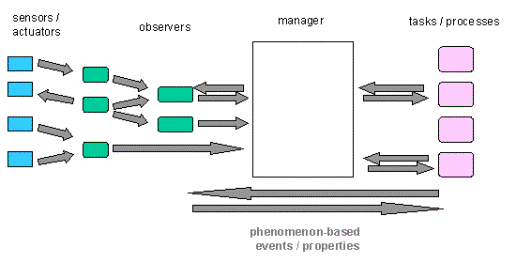
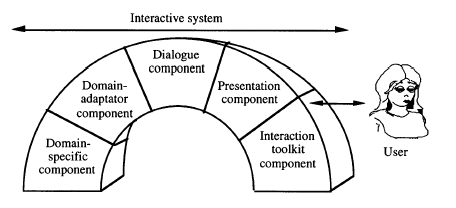
From this perspective, interactivity refers to an intelligent interface’s ability to help minimize the cognitive distance between the mental model that the user has of the task and the way in which the task is presented to the user by the computer when the task is performed (Hancock & Chignell, 1989). According to their view, an intelligent human-machine interface (HMI) is an intelligent entity that mediates between two or more interactive agents, each of which has either imperfect understanding of the way in which the others act or an imperfect understanding of the way in which the others communicate. The follow chart shows the architectural model of HCI interaction.
The Architectural Model
From
IS Literature
Rogers (1995) defined interactivity as the degree to which the technology could support or enable interaction that resembles human conversation.
Zack (1993) adopted Rogers’ definition and further identified several key characteristics of interactive communication that might be useful for differentiating communication modes:
The simultaneous
and continuous exchange of information
The use of multiple, non-verbal cues
The potentially spontaneous, unpredictable, and emergent progression of
remarks
The ability to interrupt or preempt
Mutuality
Patterns of turn-taking, and use of adjacency pairs
Burgoon et al. (2000) conceptualized interactivity according to the structural properties, or affordances, which are present in a given communication format. They decompose interactivity into its relevant properties as follows:
Participation (The
extent to which senders and receivers are actively engaged in interaction,
as opposed to giving monologues or passively observing)
Mediation (Whether the communication format is mediated or not)
Media and information richness (Whether the format utilizes one or more
modalities such as text, audio, visual, or touch, and the extent to which
the format supports symbol variety to present “rich” or “lean”
social information)
Geographic propinquity (Whether users are physically collocated or distributed)
Synchronicity (Whether interaction is same-time, which permits immediate
bi-directional feedback, or asynchronous, which permits rehearsability
and editability)
Identification (The extent to which participants are fully identified,
partially identified or anonymous)
Parallelism (Whether the format permits concurrent communication and multiple
addresses, as in the case of electronic brainstorming, or only permits
serial message)
· Anthropomorphism (The degree to which the interface simulates
or incorporates human like characteristics)
Burgoon and colleagues additionally conceptualized interactivity according to the mediating communication processes through which the above-discussed structural properties would exert their impact.
- Interaction Involvement (The degree to which users perceive they are cognitively, affectively, and behaviorally engaged in the interaction)
- Mutuality (The extent to which users perceive and create a sense of relational connection, interdependence, coordination, and understanding with one another), and
- Individuation (The extent to which users perceive they have a rich, detailed impression of the other’s identity and personalizing information)
Clark
and Brennan (1991) defined interactivity as technology-supported communication
possessing the following characteristics: Copresence, Visibility, Audibility,
Cotemporality, Simultaneity, Sequentially, Reviewability and Revisability.
(Note: For purposes of this study, Clark and Brennan (1991) ‘s definition
is adapted for measurement scales development.)
From Technology-mediated Communication Literature
Rafaeli and Sudweeks (1997) stated that interactivity is not a characteristic of the medium. It is a process-related construct about communication. For them, interactivity is the extent to which messages in a sequence relate to each other, and especially the extent to which later messages recount the relatedness of earlier messages.
In Rafaeli and Sudweeks’ study, interactivity was defined as the extent to which users can participate in modifying the form and content of a mediated environment in real time. Interactivity is thus a variable characteristic of communication settings. Formally stated, interactivity is an expression of the extent that in a given series of communication exchanges, any third (or later) transmission (or message) is related to the degree to which previous exchanges referred to even earlier transmissions (p.111).
Other definitions from this area
- Interactivity is "the facility for individuals and organizations to communicate directly with one another regardless of distance or time" (Blattberg and Deighton 1991).
- Interactivity is "the extent to which users can participate in modifying the form and content of a mediated environment in real time" (Steuer 1992).
- Interactivity is "the extent to which the communicator and the audience respond to, or are willing to facilitate, each other's communication needs" (Ha and James 1998).
- Interactivity is “a measure of a media’s potential ability to let the user exert an influence on content and/or form of the mediated communication” (Jensen 1998).
--------------------------------------------------------------------------------