









The topics of knowledge/information sharing have received considerable attention in the information systems, communication, and management literatures. The constructs have long been considered essential for effective group performance (Shaw, 1981; Stasser and Stewart, 1992). And one of their critical common attributes is that knowledge and information are both digitizable. Some researchers have studied both from different perspectives to further our understanding of the nature and effects of the constructs.
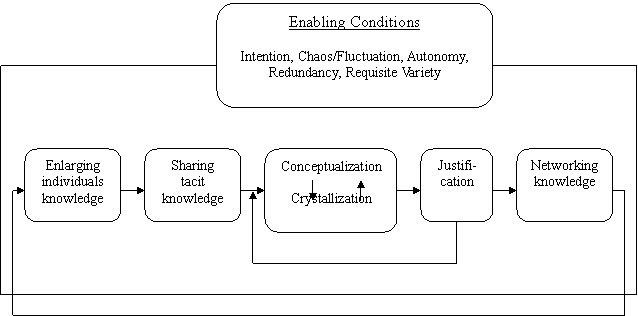
Nonaka (1994) proposes a sequential model (illustrated in the following figure) for organizational knowledge/information creation. He further suggests that the actual processes form multilayered loops and respective stages can take place simultaneously.
Process of generating information/knowledge in the market
Brynjolfsson (1994) argues that greater central coordination of information
leads to greater centralized ownership of information. A similar change
might be also happening to knowledge.
Jarvenpaa and Staples (2001) explores factors that help determine an individual's beliefs about the organizational ownership of information and knowledge that he or she has created. They suggest a collaborative type of ownership situation for both information and knowledge and for both internal and external sharing contexts.
Some studies show the impact of culture difference on knowledge/information sharing. For instance, Appleyard (1996) examines knowledge sharing patterns in the semiconductor industry. The study seeks to answer the questions of: 1) the interorganizational knowledge flow mechanism, 2) the determinants (industry characteristics and national institutions), and 3) to what extent companies direct knowledge flows. The research shows that public sources of technical data play a larger role in knowledge diffusion in Japan than in the US and in semiconductors relative to steel.
Overall, there are numerous discussions centering around these constructs. They open up avenues for exploring the impact of knowledge/information sharing theoretically and empirically. The integration of different theories is highly desirable to deepen our understanding about these two constructs. The insights of the current literatures also open intriguing possibilities both for managing and for IS scholarship. Some theoretical developments are presented in the section of "theory and definition". Meanwhile, the section of "items" outlines the measurements that have been deployed to study the constructions. These two sections are organized according to two different sharing mechanisms: knowledge as outputs (Horizontal) versus knowledge as properties (Vertical). In these two mechanisms, IS plays different roles to facilitate knowledge sharing. In what follows, two sharing mechanisms are introduced and some general distinctions between knowledge-related and information -related practices are discussed.
Sharing Mechanisms (with IS Capabilities)
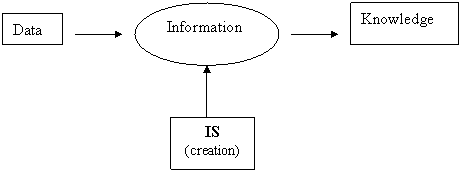
Model 1: (knowledge as outputs: horizontal)
Transformation
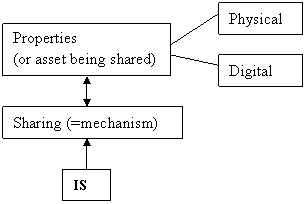
Model 2: (knowledge as properties: vertical)
Knowledge transfer vs. Information transfer
El Sawy et al. (2001) makes a difference between the transfer of information and the transfer of knowledge deploying a transportation metaphor.
Information transfer can be explained by a pure transportation metaphor, namely, a sender can deliver information by sending it to a receiver who can capture it in its form and then use it.
Knowledge transfer cannot by be explained by such metaphor as knowledge cannot be simple shared - "it has to go through a recreation process in the head of the receivers who learn". "Thus, because knowledge can only be recreated, a shared knowledge - (SK)C - process, and a shared creation - S(KC) - process for knowledge are one and the same" (pp.152).
Knowledge management vs. Information management
Knowledge management
deals with how distributed group members and their organizational colleagues
locate, store, and retrieve the data, information and knowledge that they
need for their individual and collective work (DeSanctis and Monge, 1999).
The recognition of the importance of knowledge transfer to a firm has
led to the development of knowledge management systems (KMS) intended
to enhance the knowledge transfer process.
KMS are defined as "information systems designed specifically to
facilitate codification, collection, integration, and dissemination of
organizational knowledge" (Alavi and Leidner, 1999, pp.4).
Information management
and management information systems are "synonyms that refer to an
organization system that employs information technology in providing information
and communication services and the organization function that plans, develops,
and manages the system" (Davis, 1997, pp.138).
The model of organizational memory views information management as a multilevel
phenomenon where a match between information technology and specific organizational
processes should be achieved in order to ensure the appropriate function
of organizational memory (Anand et al., 1998). This model treats the organization
as an information processor, assuming the organization needs to process
the information that comes from both within and outside the organizational
boundary.