|
CRM
Industry Overview
Professor
Langdon
IOM 538
July 1, 2002
Group
#1
Dan Buckley
Nate Hubinger
Wilson Lui
Morgan McKeown
Chris Pomeroy
Introduction
Because
the use of Customer Relationship Management applications within a corporation
is the most visible management of information to the consumer, it is
imperative for an organization to fully understand the market, the technology,
and the variety of service providers of CRM applications.
Market
CRM
can be defined as “the comprehensive approach that provides seamless
integration of every area of business that touches the customer…through
the integration of people, processes and technology” (C.G. Tugwell,
2000). To fully utilize
the potential of a CRM software package, effective customer management
must also be integrated within a corporate strategy and culture.
This is due to the fact that a customer has many points of contact
within an organization, and every customer touch-point must adopt the
CRM methods to provide quality service, thereby creating another opportunity
to sell to the customer.
As
a CRM consultant, J.D. Edwards
Business Intelligence for CRM enables a company to track key performance
indicators, such as:
- Identification
of top customers
- Margin
analysis by customer, order, product, sales representative
- Top
sales performers
- Revenue
by sales territory
- What
products are selling and which are not
- Customer
order trends
(J.D.
Edwards, 2002)
The
company searching for a CRM system has two basic options at its disposal.
On the one hand, a corporation could customize an in-house CRM
package while utilizing a consulting company such as JD Edwards mentioned
above, or on the other hand, an organization could source from a vendor
a CRM package that can be customized to fit the corporation’s specific
business needs. Depending on the objective of the company, a CRM solution
can aid in all five levels of IT-enabled business transformation: localized
exploitation, internal integration, business process redesign, business
network redesign, and business scope redefinition (Venkatraman, N. 1994,
74).
International
Data Corporation estimated the market for CRM services, including consulting,
outsourcing, and systems integration, at $33.2 billion in 1998, with
outsourcing being the largest component at $24.9 billion (United Customer
Management Solutions, 2001).
Although CRM vendors
are currently facing a weakening market, demand for applications is
expected to pick up in the fourth quarter of 2002, with 10 percent growth
this year. AMR predicts
that CRM will continue to grow at 19 percent per year for the next five
years (Brady, Anne, 2002). The
market for CRM is expected to double over the next five years, according
to AMR.
Technology
 Depending
on business needs and the variety of customer touch-points within an
organization, the CRM system can either be one software package or it
can be several various application systems that are integrated together. Depending
on business needs and the variety of customer touch-points within an
organization, the CRM system can either be one software package or it
can be several various application systems that are integrated together.
CRM
gathers customer information via a combination of customer interfaces,
such as call centers, web sites, service departments, and distribution.
CRM applications can be as simple as customer name and address
or it can be as detailed as the duration spent on web store front, temperament
of consumer complaint, order size, frequency of purchases, or product
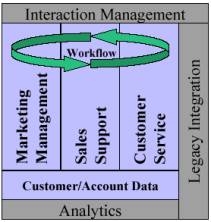
tastes. The diagram at
the right refers to typical aspects of a CRM solution, with key/core
functionalities in blue and ancillary aspects in grey (Chang, Jay 2002,
1).
The CRM provides instantaneous
customer information for various departments.
For a sales department, CRM provides services such as scheduling,
account management, compensation of salesperson, opportunity and pipeline
management, and sales forecasting.
For a marketing department, CRM offers market campaign planning,
analysis, prospect list generation and management, lead tracking, and
distribution. For customer
service and support, CRM provides services incident, defect and order
tracking, problem and solution database, repair scheduling, and dispatching
(IT Papers.com, p 3).
The
logical view of CRM function is a large relational database management
system that has powerful queries built in.
It is also accessible for various departments for additional
input and view of all the information and previous dialogue with the
customers. The CRM can
generate various reports or analysis to aid each department to better
service their customer. Furthermore,
the CRM allows each department to understand how other departments are
interacting with the customers, providing a comprehensive customer care
environment.
CRM
solutions take raw information about customers, combine it with business
rules and other sources of information, and produce interpretable real-time
information for business decisions.
The following table is a simplified example of how CRM works.
|
Input
(where information is gather and type of customer information
can obtain)
|
Processes
(processes or analysis CRM can do)
|
Output
(information to improve business result or process)
|
|
Call
center (type of question or product inquiry
|
Supply
Ordering (minimize inventory)
|
Faster
response time. Up
to date customer history
|
|
Service
department (product/component failure area, like/dislike of feature,
etc)
|
Production
(better predict future production quality level, quantity, and
feature set)
|
Improve
quality (customer call, preventive service)
|
|
|
Future
product planning
|
Focus
development effort -- future feature set to meet customer needs
|
|
Web
site (trends in order, product inquiry, customer trend)
|
Customer
profiling
|
Better
use of market money - better focus on existing customers or focus
on ignored potential customers
|
|
On
site sale
|
Quality
statistic
|
Get
close to 1 to 1 service
|
|
Survey
|
Purchase
history, preference, trend
|
Suggest
other services or products
|
The
CRM system typically consists functionally of these several logical
components:
·
Front-office automation and relational database management
system
·
Internet interface
·
Computer Telephony Integration.
But an effective CRM
implementation must provide for integration with a corporation’s existing
systems, such as legacy or UNIX based systems, to coordinate front-end
operations with back-end operations.
“The ability of a company to develop a globally wired business
network and its implementation as well as managerial components will
determine its competitive position. This requires fully integrating the customer front-end with
the supply-chain operations,” (Shaw, M.J. 2000, 16).
In
the call center and the service and support center, the system interfaces
of a CRM system can be linked with the CTI system to provide ease of
inputting new information or status of customer request (IT Papers.com,
p 4). In order to provide
consumer customization on the Internet, the CRM should link to the e-commerce
wet storefront server. In
the back-office, the CRM should link to desktop PCs to offer ease of
access of latest data for office personnel use.
An Internet interface or a wireless system should be utilized
to link CRM information to the field service personnel.
Product/Vendor
Comparison
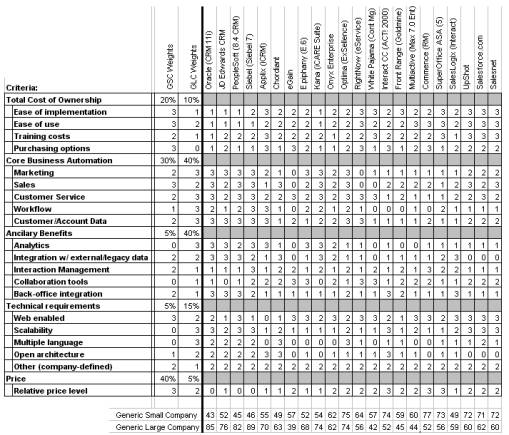
The
chart above outlines the important criteria for comparing vendors.
They fall under four main categories: Total Cost of Ownership,
Core Business Automation, Ancillary Benefits, and Technical Requirements.
Each subcategory of criteria was carefully selected to represent
the most important components of functionality.
Weights
are broken down into two components:
(1) categories of criteria (given a % rank) and (2) subcategories
of criteria (ranked on a 3-point prioritization scale where 3=high priority,
2=medium priority, 1=low priority, and 0=no value).
This allows companies to weigh the overall objectives of the
CRM in addition to prioritizing the individual components of each objective.
Vendors
are scored on a 3-point capabilities scale based on their capacity to
meet the criteria (where 3=delivered with product, 2=requires slight
modification, 1=requires heavy customization, and 0=not available/possible).
The
subcategory criteria scores are then multiplied by the vendor scores,
for a possible of 9 points in each subcategory.
These scores are then divided by the total possible points in
each subcategory (based on company’s prioritization scores), added together
with the other subcategories within the category, and multiplied by
the percentage value for the category.
Finally, the points from each category are added together, leading
to a final score (out of a possible 100 points) for each vendor.
In total, we conducted in-depth analysis and applied this process
for 22 vendors (representing dramatically different solutions) under
two different weighting schemes.
Abbreviations
and Term
Analytics-
Using data to detect trends and patterns that should be used to make
business decisions.
CRM- Customer
Relationship Management.
CTI-
Computer Telephony Integration-A term for connecting a computer to a
telephone switch and having the computer issue the switch commands to
move calls around.
Interaction
Management- Recording all details of customer interaction into a
centralized database.
Legacy
Systems- Outdated database applications, but is still too expensive
to replace.
Total
cost of ownership- Refers to the actual lifetime costs of a product, as compared to the
sticker price. These include
costs of implementation, costs of using the product (ease of use), training,
and can also include payment options.
UNIX-
An immensely powerful and complex operating system for computers for
data processing and running telephone systems.
Workflow-
The business rules and flow of information within an organization.
References
Brady,
Anne. May 30, 2002. “Enterprise
Software Still Seen Nearly Doubling in 5 Yrs.”
The Wall Street Journal.
Chang,
Jay. June 2002. “A Guide to Evaluating CRM Software.” The Customer
Relationship Management Guide [electronic document] (accessed 6/28/02);
available from http://www.crmguru.com/members/papers/solutions_guide.pdf;
Internet.
IT
Papers.com. A White Paper on CRM [electronic document] (accessed 06/26/02);
available from http://www.itpapers.com/cgi/SubcatIT.pl?scid=215/crm;
Internet.
J.D. Edwards.
May 17, 2002. Business
Intelligence for CRM [electronic document] (accessed 06/24/02); available
from http://www.jdedwards.com;
Internet.
Shaw,
M.J. 2000. Electronic Commerce:
State of the Art. In: Shaw,
M.J., A.B. Whinston et al. Handbook
on Electronic Commerce.
Tugwell,
C.G. 2000. Customer Relationship
Management [electronic document] (accessed 06/28/02); available from
http://www.beaconteleb.cwc.net/crm/tsld001.htm;
Internet.
United
Customer Management Solutions. 2001. International CRM Market Size [electronic
document] (accessed 06/22/02); available from
http://www.ucms.net/who/international.asp;
Internet.
Venkatramen,
N. 1994. “IT-Enabled Business Transformation.
Sloan Management Review (Winter).
Web Sites
http://www.crmguru.com
http://www.crmcommunity.com
http://www.dbmarketing.com/articles/Art198.htm
Offers insight into the uses of a CRM
http://www.crmxchange.com/index.html
CRM Vertical site
http://www.2020software.com/search/display.asp?tCategoryID=5&tMethod=category
CRM free demos
http://www.idg.net/go.cgi?id=480119
IDG.net CRM Knowledge Center
http://www.usms.com United Customer Management Solutions
|